
 Engagement Rings
 Wedding Rings
 Fine Jewelry
 CUSTOM DESIGN
 Diamond
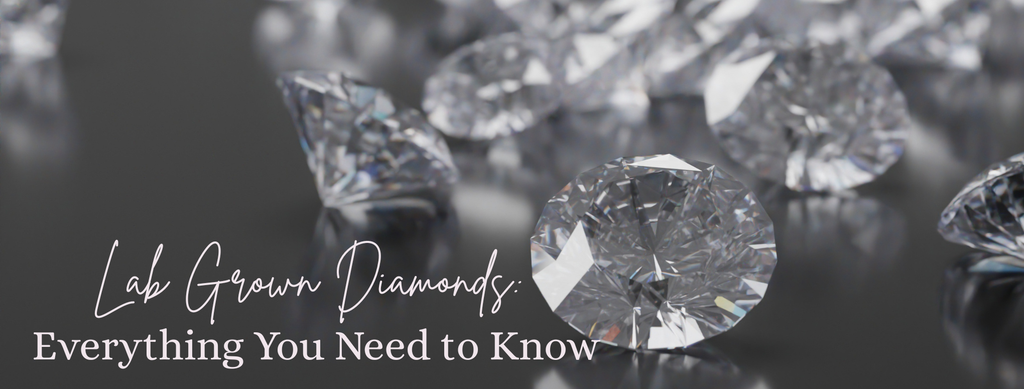
Lab Grown Diamonds: Everything You Need to Know
1. What Are Lab Grown Diamonds? How Are Lab Grown Diamonds Made?
2. Differences between Lab-Grown and Natural Diamonds
3. Benefits of Lab-Grown Diamonds
4. Common Myths About Lab Grown Diamonds
5. Uses of Lab Grown Diamonds
6. Lab diamonds versus moissanite
7. Future of Lab Grown Diamonds
8.Conclusion
9. Faqs
1. What Are Lab Grown Diamonds? How Are Lab Grown Diamonds Made?
Lab-grown diamonds are diamonds which are created in a lab and not taken out from the earth's crust. The diamonds produced by nature and the ones formed synthetically differ only in their origin, i.e., they are all the same in terms of chemical, physical, and optical properties. The production of synthetic diamonds includes two principal techniques as follows:

1. Hpht (High Pressure High Temperature): This method is designed to simulate the natural diamond producing conditions in the mantle of the Earth. A diamond is produced by subjecting carbon to extremely high pressure and temperature conditions.
2.CVD (Chemical Vapor Deposition): This method is carried out in a chamber where a carbon-rich gas is heated.The carbon atoms then slowly occupy their position on a diamond "seed" and thus grow one layer at a time. Diamonds of great quality and authenticity are yielded from both approaches.
2. Differences between Lab-Grown and Natural Diamonds

1 . Natural Diamonds : Deep in the earth's crust, natural diamonds are formed and take a billion years for the mining process to bring them up to the surface.
2. Lab grown Diamonds: In the scenario of diamonds produced in laboratories, the natural occurrence is imitated but in a matter of weeks rather than millions of years.
Still, it is possible to assert that the average person will find it very difficult to distinguish between the two types of diamonds.They are, in fact, the same in appearance, brilliance, hardness, and durability. Only highly skilled gemmologists with the latest instruments could possibly tell them apart. Meanwhile, the margin is that lab-grown diamonds are about 30-40% less expensive than natural ones.
3. Benefits of Lab-Grown Diamonds
Lab-grown diamonds have become increasingly popular, and the reasons they do so are quite strong:
1.Cost-effective: The same amount of money can buy a bigger or better quality diamond of the same category.
2.Environment-friendly: Mining is totally avoided in the process resulting in less harm to the ecosystem at large.
3.Ethical: The diamonds are free from wars and do not employ any child labor.
4.High Quality: Less number of imperfections and the best clarity are some options that are offered.
5.Modern Choice: A perfect gift for the buyer who is both conscious and tech-savvy.
4. Common Myths About Lab Grown Diamonds
A lot of myths are circulating regarding lab grown diamonds. It’s time to clarify some of them:
Myth 1: Lab-created diamonds are not fake.
Truth :They are real diamonds, not imitation diamond stones.
Myth 2: Their shine is less than that of natural diamonds
Truth: They display equal and the same amount of brilliance and fire.
Myth 3: They aren't resistant and their lifespan will be short.
Truth: Diamonds that are cultivated in laboratories possess same hardness as those that are mined from the earth and are equally durable.
Myth 4: They have no resale value
Truth: Although the resale value might be lower, they are great at the time of initial purchase.
5. Uses of Lab Grown Diamonds
Lab-grown diamonds may characterize an improved solution for consumers. Since depletion of diamond resources has disturbed the ecosystem up to a possible shutdown of diamond production, lab-grown diamonds proposed modifications to jewelry.Lab grown diamonds are still, in fact, not limited to jewelry but also many more industrial applications:

1.Jewellery: Rings, earrings, necklaces, bracelets
2.Technology: Cutting tools, heat conductors, etc.
3.Medical Equipment: Surgical tools, etc.
4.Electronics: Semiconductors, sensors, etc.
6. Lab diamonds versus moissanite
Among the countless gemstones that people confuse, the lab-created diamonds and the moissanite stand out. They do not only differ in their visual aspects but also in their formation process and properties.
1.Lab diamonds are made of 100% carbon, which is the only element that occurs in nature in the form of diamond as well.
2.Moissanite even if the latter is not a poor man's diamond but an alternative with similar characteristics that are pertaining to the composition but it contains silicon carbide instead. It is less expensive and more brilliant yet not as hard as diamond. Synthetic diamonds have a hardness of 10 on the Mohs scale while moissanite is 9.25. In case your aim is to have an authentic diamond, the lab option would be the best one.
7. Future of Lab Grown Diamonds
The future of lab-grown diamonds is definitely going to be very bright. The technology has been advancing which resulted in a decrease in the cost of manufacturing and an increase in the quality. The younger people are more willing to buy eco-friendly things which consequently leads to a higher demand.
Currently, lots of top jewelry brands are selling lab-grown diamond collections. In the future, these diamonds might become a real option, not just a choice.

Online shopping simplifies the process and allows the customers to compare quality, pricing, and certification at a glance and consequently, to build trust and transparency. Gradually, by getting educated about lab diamonds, more customers will be using them for engagement rings or fine jewelry, as they will be more sure of their choice.

The natural diamond resource being cut down drastically and the cost of mining always on the rise will bring the scenario to a point where the lab grown diamonds market will be gaining the existing market share to some extent, as per the experts' prediction. All in all, however, the future still envisions a market that is balanced between natural and lab-grown
8. CONCLUSION
In this blog, you will learn about lab grown diamonds. Lab grown diamonds are likely to look like natural diamonds.
9. FAQS
1. Are lab-grown diamonds real diamonds?
Yes, lab grown diamonds are diamonds.
2. Can you tell the difference between a lab-grown and a natural diamond?
Ofc not, you can not tell the difference between lab grown diamond and natural diamond.
3. Are lab-grown diamonds certified?
Yes, lab grown diamonds are certified.
4. Why are lab-grown diamonds cheaper?
Lab grown diamonds are cheaper than real diamonds.
5. Do lab-grown diamonds last as long as natural diamonds?
Lab grown diamonds are as good as natural diamonds.