
 Engagement Rings
 Wedding Rings
 Fine Jewelry
 CUSTOM DESIGN
 Diamond
From Carbon to Carat: The Complete Process of Making Lab Grown Diamonds
💎 The Complete Step-by-Step Process of Creating Lab-Grown Diamonds
Lab grown diamonds have revolutionized the jewelry world. They offer the same beauty, brilliance, and durability as mined diamonds — but without the environmental and ethical concerns. Whether you’re a jeweler, gem enthusiast, or curious buyer, understanding how lab-grown diamonds are made will give you a deeper appreciation of these marvels of science.
Let’s dive into the full lab-grown diamond creation process, step by step.
🔬 What Is a Lab Grown Diamond?
A lab-grown diamond (also known as a man-made, synthetic, or cultured diamond) is a real diamond created in a controlled laboratory environment rather than mined from the earth. It has the same chemical composition, crystal structure, and optical properties as a natural diamond both are pure carbon crystals arranged in a cubic structure.
🧪 Step by Step Process of Making Lab Grown Diamonds
There are two primary methods used to create lab grown diamonds:
-
HPHT (High Pressure High Temperature)
-
CVD (Chemical Vapor Deposition)
Let’s look at each process in detail.
⚙️ 1. HPHT (High Pressure High Temperature) Method
The HPHT process replicates the natural conditions deep within the Earth’s mantle where diamonds form over millions of years — but it does this in a matter of weeks.
Step 1: Create a Diamond Seed
A small piece of diamond (called a seed) is placed in a specially designed growth chamber. The seed acts as the foundation for the new diamond to grow upon.
Step 2: Add Carbon Source
A carbon source, such as graphite, is placed around the seed. This carbon will become the diamond material under extreme conditions.
Step 3: Apply Extreme Heat and Pressure
The chamber is subjected to pressures around 5 6 GPa (equivalent to the pressure 150 km below Earth’s surface) and temperatures of 1,300–1,600°C.
Under these conditions, the carbon melts and begins to crystallize around the diamond seed.
Step 4: Crystal Growth
Over several days to weeks, carbon atoms bond to the diamond seed in a cubic crystal pattern, forming a rough diamond.
Step 5: Cooling and Extraction
Once growth is complete, the chamber is cooled slowly, and the rough diamond is carefully removed and cleaned.
☁️ 2. CVD (Chemical Vapor Deposition) Method
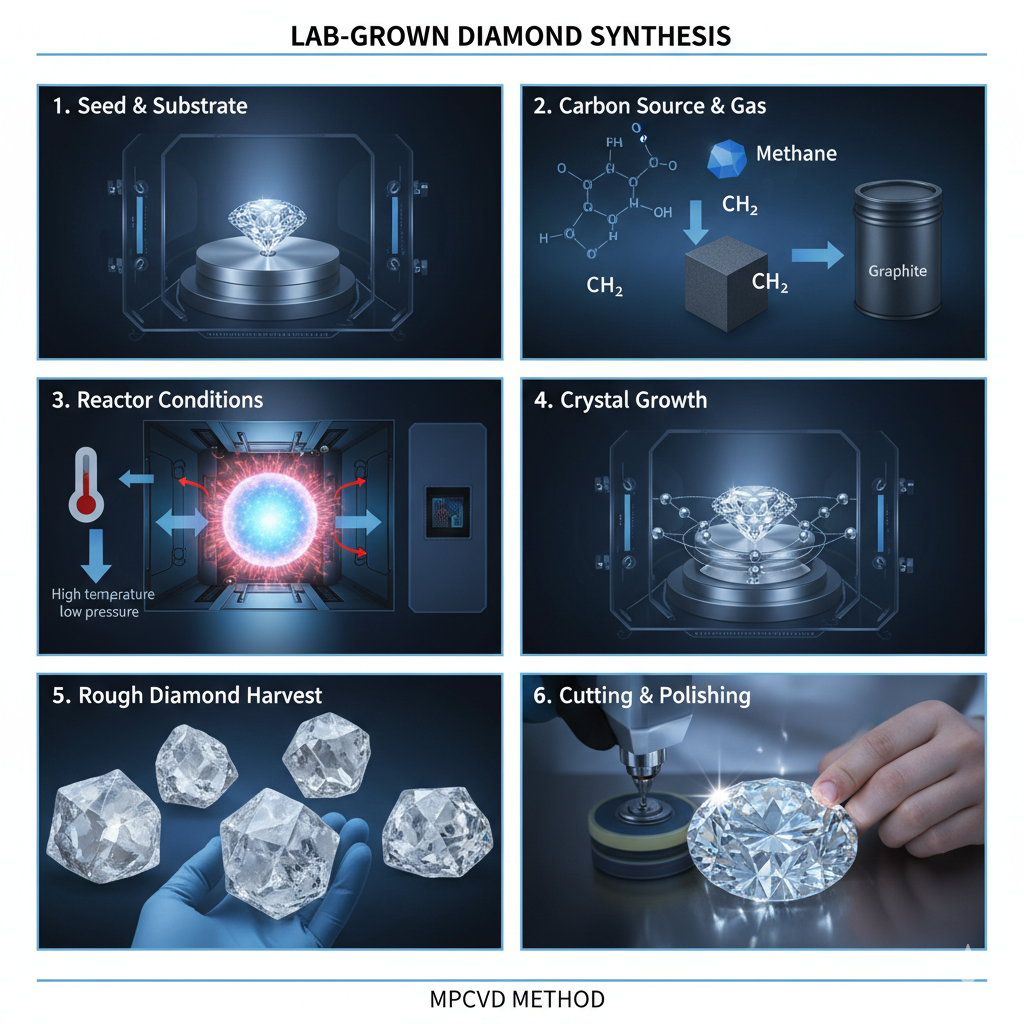
The CVD process is newer and allows for more control and larger diamond sizes. It grows diamonds layer by layer from carbon-rich gases.
Step 1: Prepare the Diamond Seed
A thin slice of diamond (often from an HPHT seed) is placed in a sealed CVD chamber.
Step 2: Introduce Carbon Gas
A mixture of hydrogen and methane gases is introduced into the chamber at low pressure.
Step 3: Heat the Chamber
The chamber is heated to about 800–1,200°C. Microwave energy or plasma is used to break down the gases into carbon atoms.
Step 4: Diamond Growth
The free carbon atoms settle onto the seed, bonding layer by layer to form a diamond crystal. This process can take several weeks, depending on the desired size.
Step 5: Post Growth Treatment
The diamond is then removed, cleaned, and sometimes subjected to HPHT treatment to improve color and clarity.
💠 3. Cutting and Polishing
Once the rough diamond is grown (either by HPHT or CVD), it undergoes the same cutting, faceting, and polishing processes as natural diamonds. Expert gem cutters shape the diamond to maximize its brilliance and fire.
🧭 4. Grading and Certification
After cutting, the diamond is sent to a gemological laboratory (such as IGI,) for grading. The diamond is evaluated on the 4Cs:
-
Cut
-
Color
-
Clarity
-
Carat Weight
The grading report will also specify that the diamond is lab grown and may include details of the growth method (HPHT or CVD).
🌍 5. Environmental & Ethical Advantages
Lab-grown diamonds offer several key benefits:
-
Conflict-free: No mining or human exploitation.
-
Eco-friendly: Significantly lower environmental impact.
-
Affordable: Typically 30–40% less expensive than mined diamonds.
-
Traceable origin: Full transparency in sourcing.
💎 Final Thoughts
Lab-grown diamonds represent the perfect harmony between science and nature. With identical physical and chemical properties to natural diamonds, they offer an ethical, sustainable, and cost effective alternative without compromising on beauty or brilliance.
Whether created through HPHT or CVD, each lab grown diamond is a testament to human innovation and precision craftsmanship.
Frequently Asked Questions (FAQs)
1. What are lab grown diamonds?
Lab-grown diamonds are real diamonds created in a laboratory using advanced technology that replicates the natural diamond-growing process. They have the same physical, chemical, and optical properties as mined diamonds.
2. How are lab-grown diamonds made?
Lab-grown diamonds are created using two main methods — HPHT (High Pressure High Temperature) and CVD (Chemical Vapor Deposition). Both processes grow diamonds from a small carbon seed under controlled conditions.
3. Are lab-grown diamonds real or fake?
Lab-grown diamonds are 100% real diamonds. The only difference is their origin — they are grown in labs instead of being mined from the earth.
4. How long does it take to make a lab-grown diamond?
On average, it takes 4 to 6 weeks to grow a diamond in a lab, depending on its size and quality.
5. Are lab grown diamonds cheaper than natural diamonds?
Yes, lab-grown diamonds are generally 30–50% more affordable than mined diamonds, offering the same sparkle and quality at a lower cost.